Tree Trimming Before Hurricane Season in Sarasota: Homeowner Preparation Guide
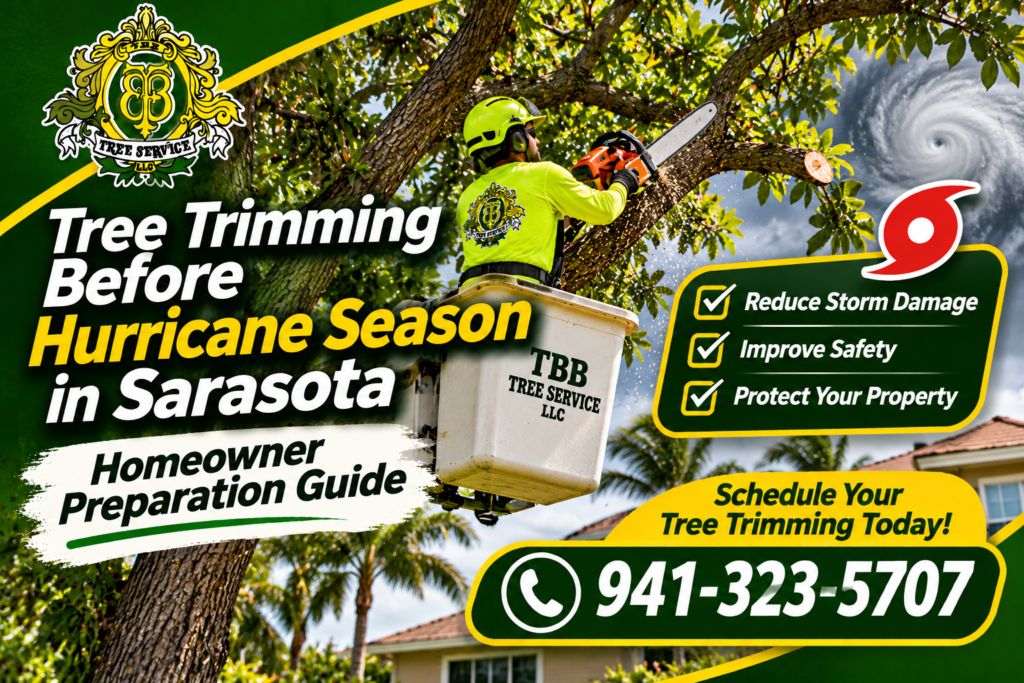
Tree Trimming Before Hurricane Season in Sarasota: Homeowner Preparation Guide
How to assess trees, prioritize proper pruning, avoid harmful hurricane cuts, and prepare your Southwest Florida property before major storms.
Tree Trimming Before Hurricane Season in Sarasota
Preparing trees before hurricane season is about identifying manageable risks, not promising that a property will be stormproof. Mature trees can provide shade and value while also needing periodic assessment for deadwood, weak attachments, or conflicts with buildings. In Sarasota and Manatee County, the combination of summer storms, heavy rain, and strong winds makes a thoughtful maintenance plan especially useful.
Start by looking at trees from the ground and noting changes since the last season. A qualified tree professional can inspect concerning conditions and explain whether selective pruning, monitoring, or removal is appropriate. Avoid treating every large tree as dangerous simply because a hurricane may occur.
When to Schedule Pre-Storm Tree Work
The best time to arrange an assessment is well before a storm threatens the area. That gives homeowners time to compare recommendations, address permits where required, and schedule qualified crews without the pressure of an approaching system. Last-minute cutting can introduce hazards and leave debris that has not been hauled away.
There is no single pruning month that suits every tree species or condition. Timing depends on tree biology, the specific defect, local weather, and professional judgment. If an immediate hazard is present, contact a qualified service rather than waiting for a calendar date.
Why Hurricane Preparation Is Not Just About Cutting Branches
A healthy canopy should not automatically be thinned or shortened. Pruning changes the way a tree grows and responds to loads, and unnecessary removal can create weak regrowth or large wounds. The objective is to address identifiable problems while preserving sound structure.
An assessment can include the trunk, branch unions, root zone, past pruning, and targets such as homes or driveways. Sometimes the best recommendation is limited corrective work; sometimes it is no pruning at all. Ask the contractor to explain the reason for each proposed cut.
Start With a Ground-Level Visual Inspection
Homeowners can look for dead branches, new leaning, cracked limbs, mushrooms near the base, or soil lifting around roots without climbing the tree. Compare current conditions with older photographs when possible. Sudden changes are generally more informative than a tree’s height alone.
Do not enter an area beneath hanging branches or touch a tree that contacts electrical wires. Make notes and photographs from safe positions. A visual check is a screening step, not a substitute for professional evaluation of structural concerns.
Dead Branches and Deadwood Removal
Dead branches can fall during ordinary weather as well as storms. Their size, location, and the people or property beneath them influence the urgency of removal. A dead limb over a frequently used walkway may warrant different attention than one in an isolated area.
Qualified crews can identify appropriate cuts and safely handle overhead material. Avoid cutting large dead branches from ladders or using improvised poles near buildings. Deadwood removal can reduce a specific hazard without requiring removal of the entire tree.
Cracked Limbs and Weak Branch Unions
Fresh cracks, separating stems, and damaged branch attachments deserve careful evaluation. Some unions have included bark or other features that may affect strength, but their risk cannot be determined from one photograph alone. Wind loading may aggravate an existing defect.
A tree professional can assess whether reduction pruning, another treatment, or removal is warranted. Do not install homemade cables or cut large limbs without understanding the load. Proper decisions depend on the tree’s condition and the nearby targets.
Leaning Trees Before Storm Season
Some trees naturally grow at an angle and remain stable for many years. A newly developed lean, however, may be associated with root movement or structural change. Look for fresh soil cracks, lifted roots, or a noticeable shift from earlier photographs.
If the lean is new or the tree threatens a structure, keep people clear and seek qualified assessment. Avoid pulling a leaning tree upright with a vehicle or attempting to correct it by removing random branches.
Root Plate Movement and Saturated Soil
Heavy rain can saturate soil and reduce support for certain trees, particularly when other root or site problems are present. Raised soil near the trunk, exposed roots, or a shifting root plate can be warning signs. Not every wet yard indicates an unstable tree.
Do not dig around structural roots to investigate on your own. A qualified professional can assess visible conditions and determine whether additional evaluation is needed. Drainage and construction history may also be relevant to the overall picture.
Trees Close to Homes and Garages
Branches over a roof are not automatically defective, but their position changes the consequences of failure. A large limb above a bedroom, garage, or outdoor living area may deserve closer review. Clearance needs vary with species, structure, and branch condition.
Ask for recommendations that protect both the building and the tree’s long-term health. Severe cutting solely to create distance can produce undesirable growth and decay. A careful plan focuses on actual conflicts and hazards.
Branches Over Driveways and Sidewalks
Driveways and walkways are frequently used targets. Deadwood, cracked limbs, or low-hanging branches may create hazards for vehicles and pedestrians. Storm preparation should account for normal daily activity as well as hurricane conditions.
A qualified tree crew can discuss selective pruning and safe clearance. Keep people away from areas where broken branches are already hanging. Routine observation after heavy winds is useful because conditions can change between scheduled visits.
Palm Tree Preparation Before Hurricanes
Palms differ from broadleaf trees in structure and pruning needs. Removing large numbers of healthy green fronds does not make a palm hurricane-proof and may reduce its ability to recover. Excessive pruning can also damage the crown.
A qualified professional should identify dead, broken, or hazardous fronds and account for the species. Avoid hurricane cuts or stripping a palm into a narrow tuft. Proper palm care prioritizes the health of the growing point and remaining canopy.
Why Hurricane Cuts on Palms Are a Bad Idea
The term hurricane cut is often used for aggressively removing green palm fronds. This practice is not a reliable storm-protection strategy and can deprive palms of useful foliage. It may also create additional maintenance problems.
Ask the contractor to explain which fronds are dead or damaged and why each proposed removal is necessary. Do not assume a severely pruned palm is safer because it appears smaller. Species-appropriate care is preferable to a one-size-fits-all cut.
Oak Tree Pruning Before Storms
Mature oaks can have wide crowns and substantial lateral limbs. Structural pruning may address selected defects, but removing too much live foliage can harm the tree. The best approach depends on the oak’s age, form, health, and prior pruning history.
A qualified arborist can evaluate branch attachments and targets beneath the canopy. Avoid indiscriminate topping or heavy interior stripping. A balanced assessment should preserve healthy branches where practical.
Pine Tree Assessment Before Hurricane Season
Pines can be tall and may fail through branch breakage, trunk failure, or uprooting depending on their condition and site. A pine’s height alone does not establish that it must be removed. Crown condition, lean, root-zone changes, and prior damage deserve attention.
Because high work can involve difficult access and falling material, leave large pine pruning to qualified crews. Ask for a specific explanation of any recommended removal. Routine topping is not an appropriate shortcut.
Live Oaks and Large Spreading Canopies
Live oaks often provide significant shade and character across Southwest Florida. Their broad crowns can extend over houses, parking areas, and neighboring lots. Large branches may need periodic assessment, especially where prior damage or weak attachments are visible.
Preservation and risk reduction should be considered together. A professional may recommend selective work rather than drastic canopy reduction. Local tree protections may also apply, so confirm requirements before major alterations.
Young Tree Structural Pruning
Young trees offer an opportunity to guide future branch structure with relatively small cuts. Addressing competing leaders or poorly spaced branches early may reduce some future maintenance problems. Young-tree work is different from heavy pruning of mature specimens.
A qualified professional can explain which branches should be retained and which may need gradual correction. Avoid removing too much foliage at once. The goal is a strong, sustainable form as the tree matures.
Mature Tree Pruning Limits
Large mature trees respond differently to pruning than young trees. Removing oversized limbs can create significant wounds, alter balance, and encourage weakly attached regrowth. Sometimes the risk of an aggressive pruning plan outweighs the expected benefit.
Ask whether the proposed cuts follow recognized arboricultural practices and whether alternatives exist. The amount removed should be justified by tree condition and objectives rather than a fixed percentage applied to every tree.
Avoid Topping Trees for Hurricane Protection
Topping removes major branches or stems without appropriate pruning targets. It can leave large wounds and encourage dense regrowth that may be poorly attached. A shorter-looking tree is not necessarily a structurally safer tree.
If a tree is too large for its location or has serious defects, discuss appropriate reduction methods, monitoring, or removal with a qualified professional. Do not request topping simply to lower the canopy before a storm.
Avoid Lion-Tailing and Excessive Thinning
Lion-tailing removes interior branches while leaving foliage concentrated near branch tips. This can change branch loading and reduce the tree’s ability to distribute growth appropriately. Heavy thinning also removes photosynthetic foliage without necessarily solving a structural problem.
Ask for a pruning plan that addresses specific defects rather than making the canopy look uniformly sparse. Good pruning decisions consider branch structure and species. More cuts do not automatically equal more protection.
Tree Cabling and Bracing Considerations
Certain trees with structural defects may be candidates for professionally designed supplemental support systems. Cabling or bracing does not make a tree fail-proof, and hardware requires ongoing inspection. It is not a substitute for evaluating the underlying condition.
Only qualified professionals should determine whether supplemental support is appropriate. Homemade ropes, chains, or hardware can damage the tree and create false confidence. Discuss limitations and maintenance requirements before installation.
When Tree Removal May Be Appropriate
Some trees have severe structural defects, extensive decline, major root failure, or unavoidable conflicts that make retention impractical. Removal may be a reasonable option after a qualified assessment. It should not be the default recommendation for every tree near a building.
Ask what evidence supports the decision and whether practical alternatives exist. Consider access, local rules, nearby utilities, and debris hauling. A written scope helps clarify the work and the expected site condition.
Trees Near Electrical Lines
Branches close to electrical conductors require specialized precautions. Homeowners should not prune near energized power lines or assume insulated-looking wires are harmless. Trees can conduct electricity, and equipment can bridge distances unexpectedly.
Contact the utility for guidance and use only appropriately qualified personnel for line-clearance work. Ordinary residential pruning should not begin until electrical hazards are addressed. Keep people and ladders away from the area.
Branches Near Solar Panels and Roof Equipment
Solar arrays, HVAC equipment, and rooftop fixtures can be damaged by falling branches. Their presence also complicates removal because of electrical systems and restricted access. A tree touching solar wiring presents hazards beyond ordinary roof clearance.
Coordinate with qualified solar or electrical personnel when necessary. Tree crews should assess the position of branches before cutting. Avoid assuming a solar system is electrically harmless during an outage.
Pool Cages and Screen Enclosures
Tree branches near pool cages can damage screens, framing, and gutters during storms. Enclosures may also restrict equipment access to backyard trees. A small opening or narrow gate can influence how wood is lowered and removed.
Ask the estimator to inspect the pool area and identify practical access routes. Pruning should protect tree health while addressing specific conflicts. Damaged enclosure repairs are separate from tree work.
Trees Along Property Lines
Branches and trunks near fences or neighboring buildings can raise access and responsibility questions. Property boundaries do not change the physical hazards of storm-damaged wood. However, ownership and permissions matter when scheduling work.
Communicate with neighbors before planned access or major pruning. Florida legal issues can be fact-specific, so consult qualified advice for disputes. Avoid making cuts that would unnecessarily damage a neighboring tree.
Check for Previous Storm Damage
A tree that survived an earlier storm may still have cracks, torn limbs, or root changes. Old pruning wounds and past limb failures can influence current condition. The absence of a recent failure does not prove that every attachment is sound.
Tell the assessor about earlier damage and any work performed afterward. Historical photographs can be helpful. A professional can prioritize defects that matter for the property’s present use.
Signs of Tree Decline
Thinning foliage, extensive deadwood, fungal growth, and unusual bark or trunk changes may warrant investigation. These signs have multiple possible causes and do not independently establish that a tree will fall. Seasonal variation and species differences also matter.
A qualified tree professional can evaluate patterns and recommend further diagnosis when needed. Avoid relying on a single symptom or automatically removing a tree because mushrooms are visible somewhere in the yard.
Construction and Root Damage
Recent trenching, driveway work, grading, or soil compaction can affect tree roots. Some damage may not become visible in the canopy immediately. Changes near the root zone are worth mentioning during a pre-storm assessment.
Do not cut large roots to make room for landscaping without professional advice. If work is planned near mature trees, coordinate with qualified professionals early. Prevention is often easier than addressing root damage after construction.
Drainage and Standing Water
Persistent standing water can influence soil conditions and tree health. A wet site may be normal for certain species, while changes in drainage can create stress or affect stability. The relevant concern is the whole site, not just the presence of puddles.
Discuss recent flooding, irrigation changes, and grading with the assessor. Drainage work may require another qualified contractor. Avoid excavating near structural roots without an informed plan.
Mulch and Soil Around the Trunk
Proper mulching can help manage soil moisture and protect the root zone from mower damage. However, piling mulch against the trunk can trap moisture and conceal problems. Deep soil added over roots may also affect tree health.
Keep the root flare appropriately exposed and avoid creating mulch volcanoes. Ask for species- and site-appropriate guidance. Mulching is a tree-care practice, not a guarantee against storm failure.
Avoid Climbing and Ladder Pruning
Homeowners sometimes attempt to cut overhead limbs with a chainsaw or pole saw from a ladder. Falling branches can strike the ladder, and the operator may not predict how tensioned wood will move. Wet ground adds another hazard.
Leave large overhead cuts to qualified crews with suitable equipment. Do not work above roofs, power lines, or occupied areas. A professional estimate can identify which tasks require specialized access.
What a Professional Tree Assessment Includes
An assessment should consider visible defects, species, age class, root conditions, past pruning, targets, and site use. Depending on the concern, a professional may recommend further investigation rather than immediate cutting. No visual inspection can reveal every hidden defect.
Ask the assessor to explain observations in plain language and distinguish urgent work from routine maintenance. Photographs and a written scope can help prioritize decisions. Avoid contractors who promise absolute hurricane resistance.
How to Prioritize Several Trees
Properties with multiple mature trees may need a prioritized maintenance plan. Focus first on identifiable hazards affecting frequently occupied areas, access routes, or structures. Tree size alone is not a sufficient ranking system.
A qualified professional can help distinguish immediate concerns from lower-priority monitoring. Phasing work can make the process more manageable without resorting to indiscriminate removal. Document which trees were assessed and why.
Tree Work for HOAs and Commercial Properties
Associations and commercial properties often have shared walkways, parking areas, and common landscapes. Their maintenance decisions affect many people and may require coordination with managers, residents, and vendors. Documentation and clear work zones are especially important.
A planned inspection schedule can help identify visible changes before peak storm periods. Confirm property access, tree ownership, and the scope of authorized work. Tree pruning and post-storm emergency response may require different arrangements.
What to Ask Before Hiring a Tree Service
Ask about the proposed cuts, work-zone safety, equipment access, cleanup, and whether the contractor can explain tree-specific recommendations. Verify appropriate insurance and qualifications. A written estimate should identify the actual work rather than vague promises to make every tree safe.
Discuss how the crew will protect nearby structures and handle unexpected conditions. Avoid accepting a recommendation based only on the tree’s height or a general statement that all branches must be removed before hurricane season.
What Tree Trimming Costs Depend On
Pricing depends on tree size, access, branch position, equipment, hazards, and cleanup requirements. A small accessible limb is different from high pruning over a roof or pool cage. The condition and number of trees also affect the scope.
Request a site-specific estimate rather than relying on generic online prices. Confirm whether hauling, stump work, and other services are included. Avoid comparing quotes that describe substantially different work.
Permits and Protected Trees
Tree rules can differ across Sarasota, Bradenton, Manatee County, and surrounding municipalities. Some removals or major alterations may require approval, while ordinary maintenance may be treated differently. Emergency situations can have distinct procedures.
Check current requirements with the appropriate local authority before authorizing major work. A qualified contractor can help identify questions, but homeowners should not assume that every tree can be removed without review.
Hurricane Watches and Warnings
Once a storm threatens the area, large tree work may become unsafe because of wind, rain, and limited time for cleanup. Do not rush into ladder cutting or leave loose piles of branches near structures. Follow official local emergency guidance.
If a dangerous tree condition is discovered immediately before a storm, contact qualified professionals and follow their safety advice. Some work may need to wait until conditions improve. Personal safety takes precedence over cosmetic pruning.
After-Storm Tree Inspection
Following severe weather, look from a safe distance for hanging limbs, new cracks, leaning trunks, and soil movement. Avoid areas beneath damaged canopies and stay away from downed wires. Do not assume that a tree is safe because it remains upright.
Report urgent hazards to the appropriate professionals. Take photographs from safe ground and keep access routes restricted when necessary. A post-storm assessment can guide targeted cleanup and future maintenance.
How Often Should Trees Be Reassessed?
There is no universal inspection interval that fits every property or tree. Frequency depends on tree condition, past defects, changes in site use, construction activity, and storm exposure. Trees with known concerns may require closer follow-up.
Ask the professional for a practical monitoring plan and what changes should trigger an earlier call. Keeping dated photos can make it easier to notice new leaning or canopy changes. Routine observation complements, but does not replace, professional evaluation.
Local Tree Care in Sarasota and Manatee County
Trees in Sarasota, Bradenton, Lakewood Ranch, Parrish, Palmetto, Venice, and nearby communities grow in varied soils and landscapes. Mature oaks, pines, palms, and ornamental trees require different care. Access can also be limited by fences, pools, and narrow side yards.
A local site assessment helps tailor pruning to the tree and property rather than using a generic storm-preparation formula. Describe known defects, nearby structures, and previous storm damage when requesting an estimate.
Final Hurricane Tree Preparation Checklist
A useful plan begins with observing changes, identifying obvious hazards, and arranging qualified assessment well before storms. Prioritize dead or damaged limbs, concerning structural defects, and conflicts with frequently used spaces. Avoid topping, excessive palm pruning, and unsafe DIY cutting.
TBB Tree Service can discuss tree trimming and removal estimates in Sarasota and Manatee County. No service can guarantee that a tree will survive a hurricane, but thoughtful maintenance can address identifiable problems and support informed property decisions.
Related TBB Tree Service Guides
proper tree pruning, leaning trees near houses, cracked trunks after storms, professional palm trimming, palm fronds over roofs, branches touching roofs, hanging limbs after storms, tree service estimates.
Independent Hurricane and Tree Care Resources
Read UF/IFAS tree care guidance, ISA tree owner resources, and Ready.gov hurricane preparedness for additional information.
Frequently Asked Questions
When should I trim trees before hurricane season?
Schedule an assessment well before storms threaten the area; exact timing depends on species and condition.
Does trimming make trees hurricane-proof?
No. Pruning may address specific defects, but no treatment guarantees storm survival.
Should I remove all green palm fronds?
No. Excessive palm pruning can harm the palm and is not a reliable hurricane-preparation method.
Is topping a good way to prevent hurricane damage?
No. Topping can create large wounds and weak regrowth.
Should I remove a tall tree near my house?
Height alone is not enough. Seek a site-specific assessment of condition and targets.
Can I prune branches near power lines?
Do not attempt it. Contact the utility and appropriately qualified personnel.
Do dead branches need to be removed?
Deadwood near people or structures can present hazards; a professional can prioritize work.
How much does pre-hurricane tree trimming cost?
It depends on size, access, equipment, hazards, and cleanup. Request an estimate.
Do I need a permit to remove a tree?
Requirements vary by jurisdiction and tree; verify current local rules.
What should I inspect after a storm?
Look safely from the ground for hanging limbs, cracks, new leaning, and root movement.