Tree Fell on Your Pergola: Emergency Removal, Damage, and Insurance
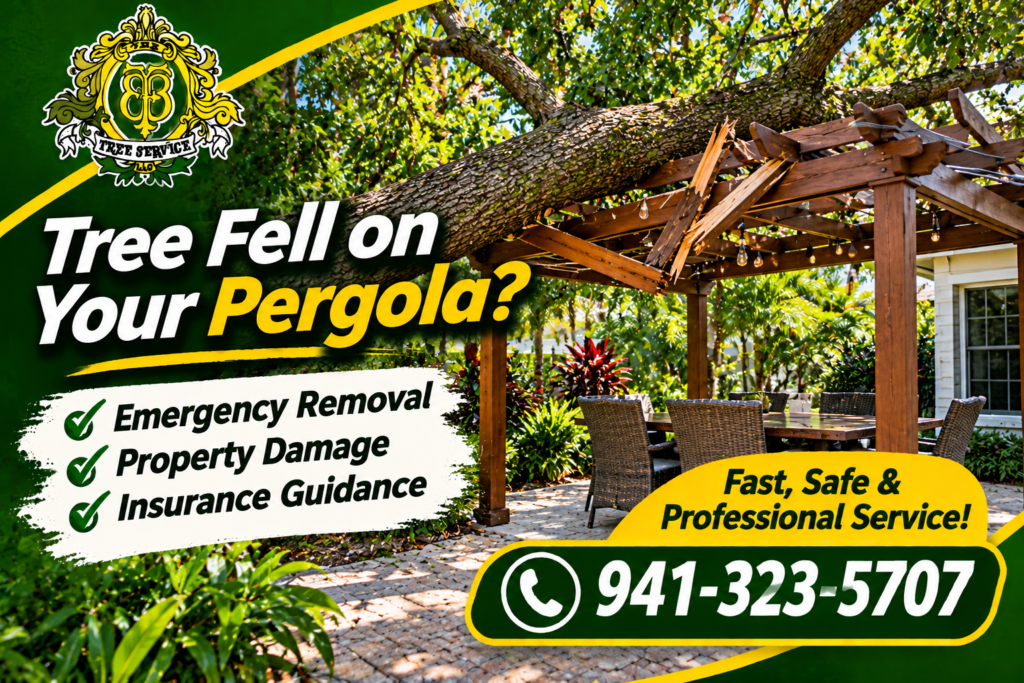
Tree Fell on Your Pergola: Emergency Removal, Damage, and Insurance
A homeowner guide to safe fallen-tree removal, patio structure damage, and repair decisions in Sarasota and Manatee County.
First steps
Keep people and pets away from the damaged pergola. Do not enter to retrieve furniture while beams or wood may shift. The right next step depends on the tree’s actual position, the condition of the structure, and whether other hazards are present. Homeowners should avoid making irreversible changes before a qualified professional has assessed the site.
Before any work starts, ask the contractor what is confirmed and what remains uncertain. The tree’s position may conceal damage to nearby connections or other branches. A safe approach considers the entire work area rather than just the most visible broken member. Document conditions from a distance and keep spectators outside the work zone.
Tree removal and structural restoration are separate responsibilities. A tree crew can evaluate and remove wood, while a qualified building contractor assesses posts, beams, anchors, and repair requirements. Electricians or other specialists may also be needed. Written scopes and coordinated scheduling help avoid unsafe overlap.
Why pergolas are vulnerable
Pergola beams are not intended to carry a falling tree trunk. Loads can transfer through posts anchors and connections. The right next step depends on the tree’s actual position, the condition of the structure, and whether other hazards are present. Homeowners should avoid making irreversible changes before a qualified professional has assessed the site.
Outdoor structures in Sarasota and Manatee County often sit close to fences, pools, landscaping, and house walls. These surroundings affect how wood can be cut, lowered, and carried away. Tell the estimator about gates, irrigation, buried services, and rain-softened ground. A careful access plan helps limit additional property damage.
Storm-damaged trees can hold tension even when the wood appears motionless. Cutting or lifting one section may change support elsewhere, including at the pergola roof. Never climb damaged framing, pull branches with a truck, or work from a ladder beneath suspended wood. Qualified professionals should control the load.
Broken crossbeams
A fractured beam may remain suspended by neighboring framing. Moving the tree can release that support suddenly. The right next step depends on the tree’s actual position, the condition of the structure, and whether other hazards are present. Homeowners should avoid making irreversible changes before a qualified professional has assessed the site.
Tree removal and structural restoration are separate responsibilities. A tree crew can evaluate and remove wood, while a qualified building contractor assesses posts, beams, anchors, and repair requirements. Electricians or other specialists may also be needed. Written scopes and coordinated scheduling help avoid unsafe overlap.
Insurance documentation should not come at the expense of safety. Preserve photographs, service estimates, and communications, but avoid entering the impact zone to collect evidence. Policy coverage and legal responsibility depend on individual facts. Contractors can document their work without promising a claim result.
Hanging branches
Storms can leave branches caught above the damaged structure. Wind and cutting operations may dislodge them. The right next step depends on the tree’s actual position, the condition of the structure, and whether other hazards are present. Homeowners should avoid making irreversible changes before a qualified professional has assessed the site.
Storm-damaged trees can hold tension even when the wood appears motionless. Cutting or lifting one section may change support elsewhere, including at the pergola roof. Never climb damaged framing, pull branches with a truck, or work from a ladder beneath suspended wood. Qualified professionals should control the load.
Before any work starts, ask the contractor what is confirmed and what remains uncertain. The tree’s position may conceal damage to nearby connections or other branches. A safe approach considers the entire work area rather than just the most visible broken member. Document conditions from a distance and keep spectators outside the work zone.
Electrical hazards
Pergolas may contain lights fans and outlets. Damaged wiring and wet metal require qualified electrical assessment. The right next step depends on the tree’s actual position, the condition of the structure, and whether other hazards are present. Homeowners should avoid making irreversible changes before a qualified professional has assessed the site.
Insurance documentation should not come at the expense of safety. Preserve photographs, service estimates, and communications, but avoid entering the impact zone to collect evidence. Policy coverage and legal responsibility depend on individual facts. Contractors can document their work without promising a claim result.
Outdoor structures in Sarasota and Manatee County often sit close to fences, pools, landscaping, and house walls. These surroundings affect how wood can be cut, lowered, and carried away. Tell the estimator about gates, irrigation, buried services, and rain-softened ground. A careful access plan helps limit additional property damage.
Safe photographs
Photograph the tree and structure from outside the danger zone. Avoid ladders and close approaches beneath broken wood. The right next step depends on the tree’s actual position, the condition of the structure, and whether other hazards are present. Homeowners should avoid making irreversible changes before a qualified professional has assessed the site.
Before any work starts, ask the contractor what is confirmed and what remains uncertain. The tree’s position may conceal damage to nearby connections or other branches. A safe approach considers the entire work area rather than just the most visible broken member. Document conditions from a distance and keep spectators outside the work zone.
Tree removal and structural restoration are separate responsibilities. A tree crew can evaluate and remove wood, while a qualified building contractor assesses posts, beams, anchors, and repair requirements. Electricians or other specialists may also be needed. Written scopes and coordinated scheduling help avoid unsafe overlap.
Heavy trunk across the roof
The trunk may be supported at several locations. Cutting one section can shift weight onto weakened framing. The right next step depends on the tree’s actual position, the condition of the structure, and whether other hazards are present. Homeowners should avoid making irreversible changes before a qualified professional has assessed the site.
Outdoor structures in Sarasota and Manatee County often sit close to fences, pools, landscaping, and house walls. These surroundings affect how wood can be cut, lowered, and carried away. Tell the estimator about gates, irrigation, buried services, and rain-softened ground. A careful access plan helps limit additional property damage.
Storm-damaged trees can hold tension even when the wood appears motionless. Cutting or lifting one section may change support elsewhere, including at the pergola roof. Never climb damaged framing, pull branches with a truck, or work from a ladder beneath suspended wood. Qualified professionals should control the load.
Large limb through the pergola
A branch may be lodged in beams or decorative slats. The remaining limb may still be attached overhead. The right next step depends on the tree’s actual position, the condition of the structure, and whether other hazards are present. Homeowners should avoid making irreversible changes before a qualified professional has assessed the site.
Tree removal and structural restoration are separate responsibilities. A tree crew can evaluate and remove wood, while a qualified building contractor assesses posts, beams, anchors, and repair requirements. Electricians or other specialists may also be needed. Written scopes and coordinated scheduling help avoid unsafe overlap.
Insurance documentation should not come at the expense of safety. Preserve photographs, service estimates, and communications, but avoid entering the impact zone to collect evidence. Policy coverage and legal responsibility depend on individual facts. Contractors can document their work without promising a claim result.
Uprooted tree near patio
Root plates can shift as the trunk is cut. Buried irrigation and nearby foundations complicate cleanup. The right next step depends on the tree’s actual position, the condition of the structure, and whether other hazards are present. Homeowners should avoid making irreversible changes before a qualified professional has assessed the site.
Storm-damaged trees can hold tension even when the wood appears motionless. Cutting or lifting one section may change support elsewhere, including at the pergola roof. Never climb damaged framing, pull branches with a truck, or work from a ladder beneath suspended wood. Qualified professionals should control the load.
Before any work starts, ask the contractor what is confirmed and what remains uncertain. The tree’s position may conceal damage to nearby connections or other branches. A safe approach considers the entire work area rather than just the most visible broken member. Document conditions from a distance and keep spectators outside the work zone.
Wooden pergola damage
Wood posts and beams may split or pull from connectors. A building contractor should assess the entire assembly. The right next step depends on the tree’s actual position, the condition of the structure, and whether other hazards are present. Homeowners should avoid making irreversible changes before a qualified professional has assessed the site.
Insurance documentation should not come at the expense of safety. Preserve photographs, service estimates, and communications, but avoid entering the impact zone to collect evidence. Policy coverage and legal responsibility depend on individual facts. Contractors can document their work without promising a claim result.
Outdoor structures in Sarasota and Manatee County often sit close to fences, pools, landscaping, and house walls. These surroundings affect how wood can be cut, lowered, and carried away. Tell the estimator about gates, irrigation, buried services, and rain-softened ground. A careful access plan helps limit additional property damage.
Aluminum pergola damage
Aluminum members can bend and twist at connections. The crew should not use damaged framing as rigging anchors. The right next step depends on the tree’s actual position, the condition of the structure, and whether other hazards are present. Homeowners should avoid making irreversible changes before a qualified professional has assessed the site.
Before any work starts, ask the contractor what is confirmed and what remains uncertain. The tree’s position may conceal damage to nearby connections or other branches. A safe approach considers the entire work area rather than just the most visible broken member. Document conditions from a distance and keep spectators outside the work zone.
Tree removal and structural restoration are separate responsibilities. A tree crew can evaluate and remove wood, while a qualified building contractor assesses posts, beams, anchors, and repair requirements. Electricians or other specialists may also be needed. Written scopes and coordinated scheduling help avoid unsafe overlap.
Steel pergola damage
Steel members and base plates may deform under impact. Do not attempt to straighten framing with a vehicle. The right next step depends on the tree’s actual position, the condition of the structure, and whether other hazards are present. Homeowners should avoid making irreversible changes before a qualified professional has assessed the site.
Outdoor structures in Sarasota and Manatee County often sit close to fences, pools, landscaping, and house walls. These surroundings affect how wood can be cut, lowered, and carried away. Tell the estimator about gates, irrigation, buried services, and rain-softened ground. A careful access plan helps limit additional property damage.
Storm-damaged trees can hold tension even when the wood appears motionless. Cutting or lifting one section may change support elsewhere, including at the pergola roof. Never climb damaged framing, pull branches with a truck, or work from a ladder beneath suspended wood. Qualified professionals should control the load.
Composite pergola damage
Composite covers can conceal damaged internal supports. Replacement should follow product-specific assessment. The right next step depends on the tree’s actual position, the condition of the structure, and whether other hazards are present. Homeowners should avoid making irreversible changes before a qualified professional has assessed the site.
Tree removal and structural restoration are separate responsibilities. A tree crew can evaluate and remove wood, while a qualified building contractor assesses posts, beams, anchors, and repair requirements. Electricians or other specialists may also be needed. Written scopes and coordinated scheduling help avoid unsafe overlap.
Insurance documentation should not come at the expense of safety. Preserve photographs, service estimates, and communications, but avoid entering the impact zone to collect evidence. Policy coverage and legal responsibility depend on individual facts. Contractors can document their work without promising a claim result.
Attached pergola risks
Impact can transfer force into the house through connections. A building professional should inspect adjoining walls. The right next step depends on the tree’s actual position, the condition of the structure, and whether other hazards are present. Homeowners should avoid making irreversible changes before a qualified professional has assessed the site.
Storm-damaged trees can hold tension even when the wood appears motionless. Cutting or lifting one section may change support elsewhere, including at the pergola roof. Never climb damaged framing, pull branches with a truck, or work from a ladder beneath suspended wood. Qualified professionals should control the load.
Before any work starts, ask the contractor what is confirmed and what remains uncertain. The tree’s position may conceal damage to nearby connections or other branches. A safe approach considers the entire work area rather than just the most visible broken member. Document conditions from a distance and keep spectators outside the work zone.
Freestanding pergola risks
Independent posts and footings can shift under a fallen trunk. A standing frame is not necessarily structurally safe. The right next step depends on the tree’s actual position, the condition of the structure, and whether other hazards are present. Homeowners should avoid making irreversible changes before a qualified professional has assessed the site.
Insurance documentation should not come at the expense of safety. Preserve photographs, service estimates, and communications, but avoid entering the impact zone to collect evidence. Policy coverage and legal responsibility depend on individual facts. Contractors can document their work without promising a claim result.
Outdoor structures in Sarasota and Manatee County often sit close to fences, pools, landscaping, and house walls. These surroundings affect how wood can be cut, lowered, and carried away. Tell the estimator about gates, irrigation, buried services, and rain-softened ground. A careful access plan helps limit additional property damage.
Pergolas near pools
Tree debris may also affect pool cages and water. Do not enter the pool beneath overhead hazards. The right next step depends on the tree’s actual position, the condition of the structure, and whether other hazards are present. Homeowners should avoid making irreversible changes before a qualified professional has assessed the site.
Before any work starts, ask the contractor what is confirmed and what remains uncertain. The tree’s position may conceal damage to nearby connections or other branches. A safe approach considers the entire work area rather than just the most visible broken member. Document conditions from a distance and keep spectators outside the work zone.
Tree removal and structural restoration are separate responsibilities. A tree crew can evaluate and remove wood, while a qualified building contractor assesses posts, beams, anchors, and repair requirements. Electricians or other specialists may also be needed. Written scopes and coordinated scheduling help avoid unsafe overlap.
Outdoor kitchen hazards
Grills gas lines and appliances can be damaged by falling wood. Report suspected fuel leaks to appropriate emergency personnel. The right next step depends on the tree’s actual position, the condition of the structure, and whether other hazards are present. Homeowners should avoid making irreversible changes before a qualified professional has assessed the site.
Outdoor structures in Sarasota and Manatee County often sit close to fences, pools, landscaping, and house walls. These surroundings affect how wood can be cut, lowered, and carried away. Tell the estimator about gates, irrigation, buried services, and rain-softened ground. A careful access plan helps limit additional property damage.
Storm-damaged trees can hold tension even when the wood appears motionless. Cutting or lifting one section may change support elsewhere, including at the pergola roof. Never climb damaged framing, pull branches with a truck, or work from a ladder beneath suspended wood. Qualified professionals should control the load.
Furniture trapped below
Belongings may be crushed or blocked by unstable branches. Wait until the area is safe before attempting retrieval. The right next step depends on the tree’s actual position, the condition of the structure, and whether other hazards are present. Homeowners should avoid making irreversible changes before a qualified professional has assessed the site.
Tree removal and structural restoration are separate responsibilities. A tree crew can evaluate and remove wood, while a qualified building contractor assesses posts, beams, anchors, and repair requirements. Electricians or other specialists may also be needed. Written scopes and coordinated scheduling help avoid unsafe overlap.
Insurance documentation should not come at the expense of safety. Preserve photographs, service estimates, and communications, but avoid entering the impact zone to collect evidence. Policy coverage and legal responsibility depend on individual facts. Contractors can document their work without promising a claim result.
Patio paver damage
Heavy wood can crack concrete or shift pavers. Removal access should consider vulnerable surfaces. The right next step depends on the tree’s actual position, the condition of the structure, and whether other hazards are present. Homeowners should avoid making irreversible changes before a qualified professional has assessed the site.
Storm-damaged trees can hold tension even when the wood appears motionless. Cutting or lifting one section may change support elsewhere, including at the pergola roof. Never climb damaged framing, pull branches with a truck, or work from a ladder beneath suspended wood. Qualified professionals should control the load.
Before any work starts, ask the contractor what is confirmed and what remains uncertain. The tree’s position may conceal damage to nearby connections or other branches. A safe approach considers the entire work area rather than just the most visible broken member. Document conditions from a distance and keep spectators outside the work zone.
Professional removal planning
Tree crews evaluate weight tension access and nearby structures. The cutting sequence should control movement of each section. The right next step depends on the tree’s actual position, the condition of the structure, and whether other hazards are present. Homeowners should avoid making irreversible changes before a qualified professional has assessed the site.
Insurance documentation should not come at the expense of safety. Preserve photographs, service estimates, and communications, but avoid entering the impact zone to collect evidence. Policy coverage and legal responsibility depend on individual facts. Contractors can document their work without promising a claim result.
Outdoor structures in Sarasota and Manatee County often sit close to fences, pools, landscaping, and house walls. These surroundings affect how wood can be cut, lowered, and carried away. Tell the estimator about gates, irrigation, buried services, and rain-softened ground. A careful access plan helps limit additional property damage.
Rigging and lifting
Large sections may require controlled lowering or mechanical assistance. Equipment choices depend on site-specific conditions. The right next step depends on the tree’s actual position, the condition of the structure, and whether other hazards are present. Homeowners should avoid making irreversible changes before a qualified professional has assessed the site.
Before any work starts, ask the contractor what is confirmed and what remains uncertain. The tree’s position may conceal damage to nearby connections or other branches. A safe approach considers the entire work area rather than just the most visible broken member. Document conditions from a distance and keep spectators outside the work zone.
Tree removal and structural restoration are separate responsibilities. A tree crew can evaluate and remove wood, while a qualified building contractor assesses posts, beams, anchors, and repair requirements. Electricians or other specialists may also be needed. Written scopes and coordinated scheduling help avoid unsafe overlap.
Chainsaw hazards
Storm-damaged branches can spring or roll when cut. Do not operate saws beneath unstable framing. The right next step depends on the tree’s actual position, the condition of the structure, and whether other hazards are present. Homeowners should avoid making irreversible changes before a qualified professional has assessed the site.
Outdoor structures in Sarasota and Manatee County often sit close to fences, pools, landscaping, and house walls. These surroundings affect how wood can be cut, lowered, and carried away. Tell the estimator about gates, irrigation, buried services, and rain-softened ground. A careful access plan helps limit additional property damage.
Storm-damaged trees can hold tension even when the wood appears motionless. Cutting or lifting one section may change support elsewhere, including at the pergola roof. Never climb damaged framing, pull branches with a truck, or work from a ladder beneath suspended wood. Qualified professionals should control the load.
Do not tow the trunk
Pulling wood with a vehicle can topple posts or tear connections. Ropes and attachment points may fail unexpectedly. The right next step depends on the tree’s actual position, the condition of the structure, and whether other hazards are present. Homeowners should avoid making irreversible changes before a qualified professional has assessed the site.
Tree removal and structural restoration are separate responsibilities. A tree crew can evaluate and remove wood, while a qualified building contractor assesses posts, beams, anchors, and repair requirements. Electricians or other specialists may also be needed. Written scopes and coordinated scheduling help avoid unsafe overlap.
Insurance documentation should not come at the expense of safety. Preserve photographs, service estimates, and communications, but avoid entering the impact zone to collect evidence. Policy coverage and legal responsibility depend on individual facts. Contractors can document their work without promising a claim result.
Protect nearby fencing
Logs and equipment can affect fences landscaping and irrigation. Discuss practical protection measures before work begins. The right next step depends on the tree’s actual position, the condition of the structure, and whether other hazards are present. Homeowners should avoid making irreversible changes before a qualified professional has assessed the site.
Storm-damaged trees can hold tension even when the wood appears motionless. Cutting or lifting one section may change support elsewhere, including at the pergola roof. Never climb damaged framing, pull branches with a truck, or work from a ladder beneath suspended wood. Qualified professionals should control the load.
Before any work starts, ask the contractor what is confirmed and what remains uncertain. The tree’s position may conceal damage to nearby connections or other branches. A safe approach considers the entire work area rather than just the most visible broken member. Document conditions from a distance and keep spectators outside the work zone.
Narrow backyard access
Many Florida patios are reached through small side gates. Limited access can change equipment and removal methods. The right next step depends on the tree’s actual position, the condition of the structure, and whether other hazards are present. Homeowners should avoid making irreversible changes before a qualified professional has assessed the site.
Insurance documentation should not come at the expense of safety. Preserve photographs, service estimates, and communications, but avoid entering the impact zone to collect evidence. Policy coverage and legal responsibility depend on individual facts. Contractors can document their work without promising a claim result.
Outdoor structures in Sarasota and Manatee County often sit close to fences, pools, landscaping, and house walls. These surroundings affect how wood can be cut, lowered, and carried away. Tell the estimator about gates, irrigation, buried services, and rain-softened ground. A careful access plan helps limit additional property damage.
Power lines nearby
Wood touching electrical conductors may be energized. Contact the utility and keep everyone away. The right next step depends on the tree’s actual position, the condition of the structure, and whether other hazards are present. Homeowners should avoid making irreversible changes before a qualified professional has assessed the site.
Before any work starts, ask the contractor what is confirmed and what remains uncertain. The tree’s position may conceal damage to nearby connections or other branches. A safe approach considers the entire work area rather than just the most visible broken member. Document conditions from a distance and keep spectators outside the work zone.
Tree removal and structural restoration are separate responsibilities. A tree crew can evaluate and remove wood, while a qualified building contractor assesses posts, beams, anchors, and repair requirements. Electricians or other specialists may also be needed. Written scopes and coordinated scheduling help avoid unsafe overlap.
Cracked remaining tree
A broken limb can leave a split in the standing trunk. The remaining canopy needs a qualified assessment. The right next step depends on the tree’s actual position, the condition of the structure, and whether other hazards are present. Homeowners should avoid making irreversible changes before a qualified professional has assessed the site.
Outdoor structures in Sarasota and Manatee County often sit close to fences, pools, landscaping, and house walls. These surroundings affect how wood can be cut, lowered, and carried away. Tell the estimator about gates, irrigation, buried services, and rain-softened ground. A careful access plan helps limit additional property damage.
Storm-damaged trees can hold tension even when the wood appears motionless. Cutting or lifting one section may change support elsewhere, including at the pergola roof. Never climb damaged framing, pull branches with a truck, or work from a ladder beneath suspended wood. Qualified professionals should control the load.
Should the whole tree go
One broken limb does not always justify full tree removal. Evaluate condition roots and nearby targets individually. The right next step depends on the tree’s actual position, the condition of the structure, and whether other hazards are present. Homeowners should avoid making irreversible changes before a qualified professional has assessed the site.
Tree removal and structural restoration are separate responsibilities. A tree crew can evaluate and remove wood, while a qualified building contractor assesses posts, beams, anchors, and repair requirements. Electricians or other specialists may also be needed. Written scopes and coordinated scheduling help avoid unsafe overlap.
Insurance documentation should not come at the expense of safety. Preserve photographs, service estimates, and communications, but avoid entering the impact zone to collect evidence. Policy coverage and legal responsibility depend on individual facts. Contractors can document their work without promising a claim result.
Insurance for pergola damage
Coverage depends on policy terms and structure type. Ask the insurer about outdoor structures and debris removal. The right next step depends on the tree’s actual position, the condition of the structure, and whether other hazards are present. Homeowners should avoid making irreversible changes before a qualified professional has assessed the site.
Storm-damaged trees can hold tension even when the wood appears motionless. Cutting or lifting one section may change support elsewhere, including at the pergola roof. Never climb damaged framing, pull branches with a truck, or work from a ladder beneath suspended wood. Qualified professionals should control the load.
Before any work starts, ask the contractor what is confirmed and what remains uncertain. The tree’s position may conceal damage to nearby connections or other branches. A safe approach considers the entire work area rather than just the most visible broken member. Document conditions from a distance and keep spectators outside the work zone.
Neighbor tree liability
The tree location does not automatically establish responsibility. Prior warnings condition and Florida law can matter. The right next step depends on the tree’s actual position, the condition of the structure, and whether other hazards are present. Homeowners should avoid making irreversible changes before a qualified professional has assessed the site.
Insurance documentation should not come at the expense of safety. Preserve photographs, service estimates, and communications, but avoid entering the impact zone to collect evidence. Policy coverage and legal responsibility depend on individual facts. Contractors can document their work without promising a claim result.
Outdoor structures in Sarasota and Manatee County often sit close to fences, pools, landscaping, and house walls. These surroundings affect how wood can be cut, lowered, and carried away. Tell the estimator about gates, irrigation, buried services, and rain-softened ground. A careful access plan helps limit additional property damage.
Dead tree before storm
Earlier dieback or decay may be relevant to the claim. Such signs do not automatically prove negligence. The right next step depends on the tree’s actual position, the condition of the structure, and whether other hazards are present. Homeowners should avoid making irreversible changes before a qualified professional has assessed the site.
Before any work starts, ask the contractor what is confirmed and what remains uncertain. The tree’s position may conceal damage to nearby connections or other branches. A safe approach considers the entire work area rather than just the most visible broken member. Document conditions from a distance and keep spectators outside the work zone.
Tree removal and structural restoration are separate responsibilities. A tree crew can evaluate and remove wood, while a qualified building contractor assesses posts, beams, anchors, and repair requirements. Electricians or other specialists may also be needed. Written scopes and coordinated scheduling help avoid unsafe overlap.
Healthy tree in storm
Strong winds and saturated soil can cause unexpected failures. Avoid assigning fault without evidence. The right next step depends on the tree’s actual position, the condition of the structure, and whether other hazards are present. Homeowners should avoid making irreversible changes before a qualified professional has assessed the site.
Outdoor structures in Sarasota and Manatee County often sit close to fences, pools, landscaping, and house walls. These surroundings affect how wood can be cut, lowered, and carried away. Tell the estimator about gates, irrigation, buried services, and rain-softened ground. A careful access plan helps limit additional property damage.
Storm-damaged trees can hold tension even when the wood appears motionless. Cutting or lifting one section may change support elsewhere, including at the pergola roof. Never climb damaged framing, pull branches with a truck, or work from a ladder beneath suspended wood. Qualified professionals should control the load.
Removal cost factors
Tree size position access and hazards affect scope. Request a written site-specific estimate rather than generic pricing. The right next step depends on the tree’s actual position, the condition of the structure, and whether other hazards are present. Homeowners should avoid making irreversible changes before a qualified professional has assessed the site.
Tree removal and structural restoration are separate responsibilities. A tree crew can evaluate and remove wood, while a qualified building contractor assesses posts, beams, anchors, and repair requirements. Electricians or other specialists may also be needed. Written scopes and coordinated scheduling help avoid unsafe overlap.
Insurance documentation should not come at the expense of safety. Preserve photographs, service estimates, and communications, but avoid entering the impact zone to collect evidence. Policy coverage and legal responsibility depend on individual facts. Contractors can document their work without promising a claim result.
Written removal estimates
The quote should identify cutting hauling access and exclusions. Confirm whether stump grinding is included. The right next step depends on the tree’s actual position, the condition of the structure, and whether other hazards are present. Homeowners should avoid making irreversible changes before a qualified professional has assessed the site.
Storm-damaged trees can hold tension even when the wood appears motionless. Cutting or lifting one section may change support elsewhere, including at the pergola roof. Never climb damaged framing, pull branches with a truck, or work from a ladder beneath suspended wood. Qualified professionals should control the load.
Before any work starts, ask the contractor what is confirmed and what remains uncertain. The tree’s position may conceal damage to nearby connections or other branches. A safe approach considers the entire work area rather than just the most visible broken member. Document conditions from a distance and keep spectators outside the work zone.
Debris hauling
Tree debris and broken building materials may require different services. Clarify where logs and chips will be left. The right next step depends on the tree’s actual position, the condition of the structure, and whether other hazards are present. Homeowners should avoid making irreversible changes before a qualified professional has assessed the site.
Insurance documentation should not come at the expense of safety. Preserve photographs, service estimates, and communications, but avoid entering the impact zone to collect evidence. Policy coverage and legal responsibility depend on individual facts. Contractors can document their work without promising a claim result.
Outdoor structures in Sarasota and Manatee County often sit close to fences, pools, landscaping, and house walls. These surroundings affect how wood can be cut, lowered, and carried away. Tell the estimator about gates, irrigation, buried services, and rain-softened ground. A careful access plan helps limit additional property damage.
Stump grinding
Grinding is often separate from fallen-tree removal. Locate buried utilities before excavation. The right next step depends on the tree’s actual position, the condition of the structure, and whether other hazards are present. Homeowners should avoid making irreversible changes before a qualified professional has assessed the site.
Before any work starts, ask the contractor what is confirmed and what remains uncertain. The tree’s position may conceal damage to nearby connections or other branches. A safe approach considers the entire work area rather than just the most visible broken member. Document conditions from a distance and keep spectators outside the work zone.
Tree removal and structural restoration are separate responsibilities. A tree crew can evaluate and remove wood, while a qualified building contractor assesses posts, beams, anchors, and repair requirements. Electricians or other specialists may also be needed. Written scopes and coordinated scheduling help avoid unsafe overlap.
Repair or rebuild
The extent of damage to posts beams and anchors determines options. Qualified contractors should evaluate the structure. The right next step depends on the tree’s actual position, the condition of the structure, and whether other hazards are present. Homeowners should avoid making irreversible changes before a qualified professional has assessed the site.
Outdoor structures in Sarasota and Manatee County often sit close to fences, pools, landscaping, and house walls. These surroundings affect how wood can be cut, lowered, and carried away. Tell the estimator about gates, irrigation, buried services, and rain-softened ground. A careful access plan helps limit additional property damage.
Storm-damaged trees can hold tension even when the wood appears motionless. Cutting or lifting one section may change support elsewhere, including at the pergola roof. Never climb damaged framing, pull branches with a truck, or work from a ladder beneath suspended wood. Qualified professionals should control the load.
Temporary protection
A damaged pergola is not a safe support for improvised tarps. Move belongings only after safe access is established. The right next step depends on the tree’s actual position, the condition of the structure, and whether other hazards are present. Homeowners should avoid making irreversible changes before a qualified professional has assessed the site.
Tree removal and structural restoration are separate responsibilities. A tree crew can evaluate and remove wood, while a qualified building contractor assesses posts, beams, anchors, and repair requirements. Electricians or other specialists may also be needed. Written scopes and coordinated scheduling help avoid unsafe overlap.
Insurance documentation should not come at the expense of safety. Preserve photographs, service estimates, and communications, but avoid entering the impact zone to collect evidence. Policy coverage and legal responsibility depend on individual facts. Contractors can document their work without promising a claim result.
Local permits
Tree removal and pergola reconstruction may involve different rules. Check requirements with the appropriate local authority. The right next step depends on the tree’s actual position, the condition of the structure, and whether other hazards are present. Homeowners should avoid making irreversible changes before a qualified professional has assessed the site.
Storm-damaged trees can hold tension even when the wood appears motionless. Cutting or lifting one section may change support elsewhere, including at the pergola roof. Never climb damaged framing, pull branches with a truck, or work from a ladder beneath suspended wood. Qualified professionals should control the load.
Before any work starts, ask the contractor what is confirmed and what remains uncertain. The tree’s position may conceal damage to nearby connections or other branches. A safe approach considers the entire work area rather than just the most visible broken member. Document conditions from a distance and keep spectators outside the work zone.
HOA considerations
Shared amenities and association rules may affect authorization. Keep unsafe spaces closed while responsibilities are clarified. The right next step depends on the tree’s actual position, the condition of the structure, and whether other hazards are present. Homeowners should avoid making irreversible changes before a qualified professional has assessed the site.
Insurance documentation should not come at the expense of safety. Preserve photographs, service estimates, and communications, but avoid entering the impact zone to collect evidence. Policy coverage and legal responsibility depend on individual facts. Contractors can document their work without promising a claim result.
Outdoor structures in Sarasota and Manatee County often sit close to fences, pools, landscaping, and house walls. These surroundings affect how wood can be cut, lowered, and carried away. Tell the estimator about gates, irrigation, buried services, and rain-softened ground. A careful access plan helps limit additional property damage.
Preventive pruning
Proper pruning can reduce some conflicts near patios. No maintenance program guarantees storm resistance. The right next step depends on the tree’s actual position, the condition of the structure, and whether other hazards are present. Homeowners should avoid making irreversible changes before a qualified professional has assessed the site.
Before any work starts, ask the contractor what is confirmed and what remains uncertain. The tree’s position may conceal damage to nearby connections or other branches. A safe approach considers the entire work area rather than just the most visible broken member. Document conditions from a distance and keep spectators outside the work zone.
Tree removal and structural restoration are separate responsibilities. A tree crew can evaluate and remove wood, while a qualified building contractor assesses posts, beams, anchors, and repair requirements. Electricians or other specialists may also be needed. Written scopes and coordinated scheduling help avoid unsafe overlap.
Hurricane preparation
Arrange tree assessments before severe weather arrives. Avoid rushed dangerous cutting as a storm approaches. The right next step depends on the tree’s actual position, the condition of the structure, and whether other hazards are present. Homeowners should avoid making irreversible changes before a qualified professional has assessed the site.
Outdoor structures in Sarasota and Manatee County often sit close to fences, pools, landscaping, and house walls. These surroundings affect how wood can be cut, lowered, and carried away. Tell the estimator about gates, irrigation, buried services, and rain-softened ground. A careful access plan helps limit additional property damage.
Storm-damaged trees can hold tension even when the wood appears motionless. Cutting or lifting one section may change support elsewhere, including at the pergola roof. Never climb damaged framing, pull branches with a truck, or work from a ladder beneath suspended wood. Qualified professionals should control the load.
Sarasota conditions
Heavy rain and tight yards can complicate removal operations. Local assessments should account for access and utilities. The right next step depends on the tree’s actual position, the condition of the structure, and whether other hazards are present. Homeowners should avoid making irreversible changes before a qualified professional has assessed the site.
Tree removal and structural restoration are separate responsibilities. A tree crew can evaluate and remove wood, while a qualified building contractor assesses posts, beams, anchors, and repair requirements. Electricians or other specialists may also be needed. Written scopes and coordinated scheduling help avoid unsafe overlap.
Insurance documentation should not come at the expense of safety. Preserve photographs, service estimates, and communications, but avoid entering the impact zone to collect evidence. Policy coverage and legal responsibility depend on individual facts. Contractors can document their work without promising a claim result.
Coordinating contractors
Tree crews and building specialists handle different tasks. Clear written scopes prevent gaps in restoration. The right next step depends on the tree’s actual position, the condition of the structure, and whether other hazards are present. Homeowners should avoid making irreversible changes before a qualified professional has assessed the site.
Storm-damaged trees can hold tension even when the wood appears motionless. Cutting or lifting one section may change support elsewhere, including at the pergola roof. Never climb damaged framing, pull branches with a truck, or work from a ladder beneath suspended wood. Qualified professionals should control the load.
Before any work starts, ask the contractor what is confirmed and what remains uncertain. The tree’s position may conceal damage to nearby connections or other branches. A safe approach considers the entire work area rather than just the most visible broken member. Document conditions from a distance and keep spectators outside the work zone.
Final safety checklist
Keep clear of unstable wood and damaged framing. Arrange professional removal before returning to ordinary patio use. The right next step depends on the tree’s actual position, the condition of the structure, and whether other hazards are present. Homeowners should avoid making irreversible changes before a qualified professional has assessed the site.
Insurance documentation should not come at the expense of safety. Preserve photographs, service estimates, and communications, but avoid entering the impact zone to collect evidence. Policy coverage and legal responsibility depend on individual facts. Contractors can document their work without promising a claim result.
Outdoor structures in Sarasota and Manatee County often sit close to fences, pools, landscaping, and house walls. These surroundings affect how wood can be cut, lowered, and carried away. Tell the estimator about gates, irrigation, buried services, and rain-softened ground. A careful access plan helps limit additional property damage.
Related TBB Tree Service Guides
trees on carports, trees on pool cages, trees on fences, trees on sheds, hanging storm limbs, cracked tree trunks, leaning trees, tree service estimates.
Independent Safety Resources
Review OSHA tree care safety, OSHA electrical safety, and UF/IFAS tree care guidance.
Frequently Asked Questions
Can I remove the branch myself?
Heavy or tensioned wood can shift unexpectedly; professional assessment is recommended.
Does insurance cover pergola damage?
Coverage depends on the policy, cause of loss, and structure.
Who pays if the tree came from next door?
Responsibility depends on the facts and applicable law.
Can a pergola be repaired?
A qualified contractor should assess beams, posts, connections, and anchors.
How much does removal cost?
Size, access, equipment, and hazards determine the estimate.
Will the tree service rebuild the pergola?
Tree removal and structural repairs are separate services.
Is it safe to use the patio afterward?
Wait for structural and other hazard assessments.
Is stump grinding included?
Confirm it separately in writing.
What if lights were damaged?
Avoid wiring and contact a qualified electrician.
Should the remaining tree be removed?
Only after a site-specific evaluation of its condition.